Psychological Awareness?Techniques and ModelsThe PTM FrameworkThreat ResponsesAnxietyFurther Resources
What is Psychological Awareness?
Psychological Awareness is about:
- The need for service providers to act competently, with understanding, empathy, tolerance and compassion.
- To have an understanding and to be able to apply different psychological models and techniques to their work, as appropriate
- Understanding connection between thoughts, feelings and behaviour
- To be sensitive to age, culture, gender, disability, sexuality, ethnicity and other factors that impact on people’s experiences of services
- Clear organisational commitment to PIE and trauma informed practice
Plymouth Examples
The Compassionate Approach to Child Health and Weight
Trauma Informed Recruitment Toolkit
Trauma Informed Recruitment of the Changing Futures Peer Researchers – Video
This video is hidden until you accept cookies, because playing it would let YouTube or Vimeo store information on your device.
Different Techniques and Psychological Models
A range of techniques and psychological models can be applied in practice:
- ABCD (Asset-Based Community Development)
- Strengths-Based Positive Psychology
- Solution-Focused Practice
- Trauma Stabilisation
- ACT (Acceptance and Commitment Therapy)
- Quest Narrative Tool
- Power Threat Meaning Framework
The Power Threat Meaning (PTM) Framework
The PTM Framework asks key questions to help understand people’s experiences:
- What are our strengths, assets and resources?
- What has happened to us?
- How did it affect us?
- What threat responses have we adopted?
- How do we understand our responses?
- The stories we believe about ourselves (our narrative) shape and limit how we behave.
Different Forms of Power
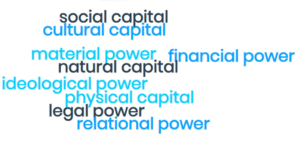
Ideological Power
- Power of ideas, control of language, thoughts and meanings
- What is taken for granted? who is advantaged or disadvantaged by particular widely-held assumptions
- Meanings linked to financial power/economic/ material power
- Influenced by cultural messages about hard work and self-reliance
- Impacts on how people treat themselves and others.
Threat Responses
- Asking for and receiving help can pose a threat in itself
- It can be very difficult if people are feeling threatened from multiple sources
- People are often not in control of the threats they face, or their responses.
- Threats are often interrelated
- Different responses are judged differently by others
- The importance of calm, compassionate co-regulation from the service provider
Common threat responses include:
- Hiding away
- Retreating to a childlike response
- Becoming defensive
- Blaming others
- Hypervigilance
- Disassociation
- Comforting/numbing behaviours
- ‘The body keeps the score’ – Physical Manifestations of Trauma
- Anxiety- fear, sickness, feeling out of control, shame, worry, catastrophizing, panic
Anxiety
Anxiety is a normal survival response, to prepare and enable us to take action. It helps us to take reasonable risks, in order to achieve something.
- Anxiety is a self-protection and early warning system
- It may be short-term, ongoing, or completely debilitating
- It can be disproportionate to the actual threat
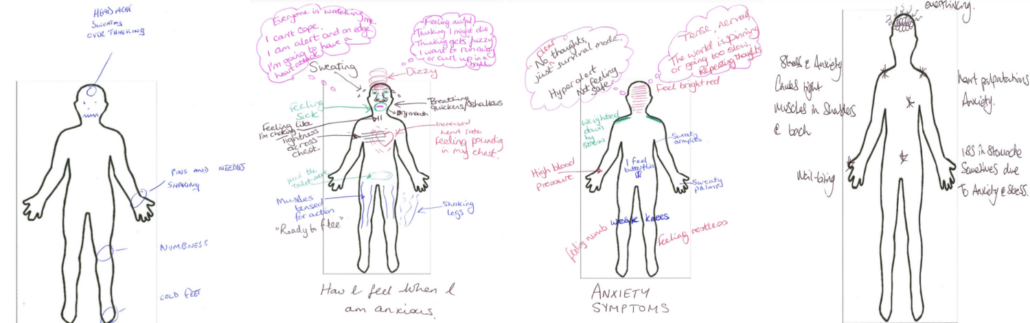
- It has physical manifestations which are often difficult to articulate
- It can help performance in some situations
- It can also trigger self-sabotage and can often be often framed as weakness
Anxiety Reflective Exercise
A reflective exercise to explore your own experience of anxiety:
- Think of an experience of anxiety you have had.
- What did it feel like?
- What were you thinking?
- What was the social situation/ context?
- What triggered the anxiety?
- Were there any additional thoughts or feelings?
- What was your behaviour?
- What helped you cope?
- What hindered you?
- What was the outcome?
- What did you learn from this?
Plymouth Examples
Drawings made by participants on Shekinah’s Re:develop and Level 2 Mental Health Awareness courses — learners are invited to ‘draw the feeling’, locating physical and mental symptoms of anxiety on a body map as a starting point for exploring fight/flight/freeze/fawn responses.
Plymouth Access to Housing (PATH)
Working with a women who has been rough sleeping for a long time.
This is an example shared by a staff member from PATH, of being alongside someone who is displaying behaviours that are threat responses and how they have been supported:
“She is a Female woman in her 30’s and she is significantly neuro divergent and emotionally dysregulated through significant historical trauma. She is a heavy substance misuser and has been rough sleeping for long periods of time within the time I have supported her. I have been working with her for three years and I have slowly witnessed her options of housing become less and less this, due to her complexities as a drug user and her behaviour around this.
This female can be perceived as chaotic, loud, perhaps aggressive. However, being neuro divergent often means her behaviour and communication is misinterpreted. I continue to advocate for her to get her needs met and provide clear understanding of her true nature to ensure we as a service, help get her needs met through the assistance of the alliance. I work with this lady using trauma informed practice. By accepting this lady as a human with complexities, by spending time and being patient and listening to what this lady hopes to achieve can sometimes be difficult as I’m not always able to provide the things she wants. However, through little steps, I know that my commitment and time growing our professional relationship will give her confidence and reassurance that someone cares to walk by her side and fighting her corner.”
Resources
- British Psychological Society (2024) The Power Threat Meaning Framework. Available at: Power Threat Meaning Framework
- Devon Mental Health Alliance
- Middleton, R. (2024) Ladder 4 Life Programme. Available at: https://www.ladder4life.com/
- PIELink — A Practice Exchange for Psychologically Informed Environments
